














⛏️ Bitcoin Mints 20 Millionth Coin as Scarcity Era Begins
March 12, 2026
Illiquid supply will violently squeeze available exchange balances as long-term holders refuse to sell.
The energy cost to mine a single Bitcoin will mandate aggressive consolidation among institutional mining operations.
Derivative markets will experience massive premium expansion as access to spot Bitcoin becomes increasingly restricted.
We will see a paradigm shift where Bitcoin is valued less against fiat currency and more against scarce real estate and energy.
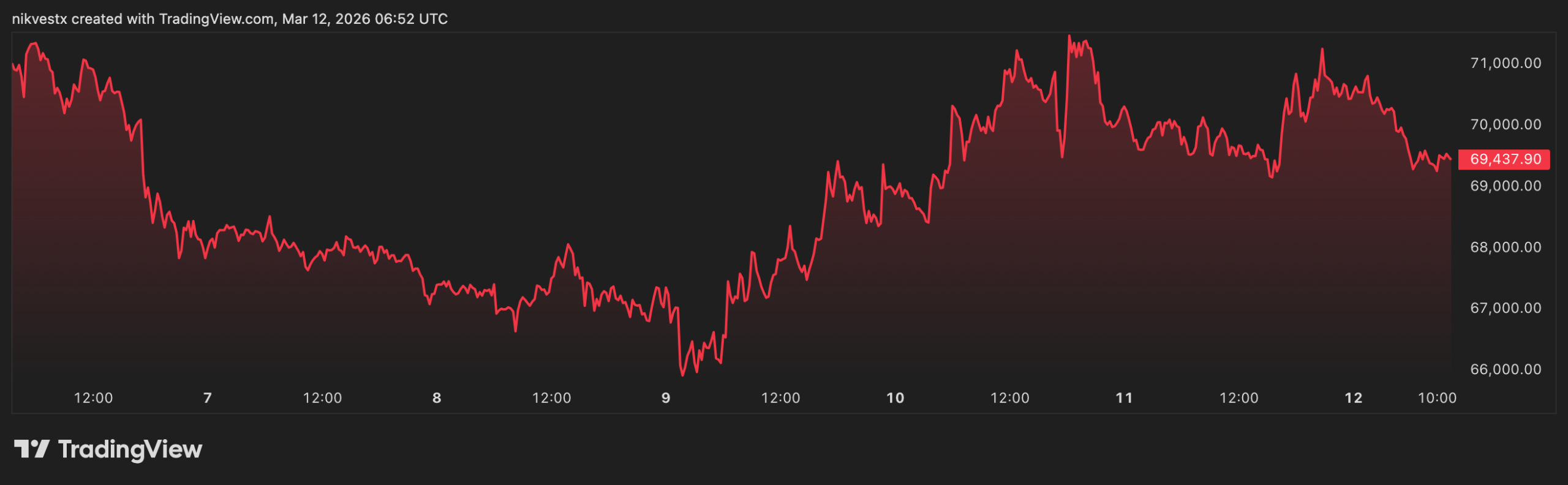
Bitcoin is currently hovering in a tight consolidation zone between $65,500 and $66,200. While the surface looks quiet, under the hood, we are seeing severe conflicting signals and warning signs of high volatility.
Here is a clear, human breakdown of what the macro, micro, and on-chain data are actually telling us right now.
1. The Macro Engine (Status: Headwinds)
The broader economic picture is currently putting pressure on crypto assets. The U.S. Dollar Index (DXY) is testing heavy resistance in the 99.5–100.35 range. Here is why the dollar is flexing:
The Fed Reality: The Federal Reserve has paused rates at the 3.50%–3.75% range. With sticky services inflation (ISM prices paid at 61.5) and a stubbornly resilient job market, the rate cuts everyone anticipated have been priced out.
Geopolitics & Flight to Safety: We are seeing a sharp influx of geopolitical risk premiums, pushing Brent crude above $95/bbl. The VIX is highly sensitive.
The Takeaway: Bitcoin acts as the anti-dollar. Right now, delayed easing and global uncertainty are stalling net liquidity and giving the dollar the upper hand.
2. Market Mechanics & Order Flow (Status: Neutral to Bearish)
Looking at the actual order books, Bitcoin is currently trapped below its 20-, 50-, and 100-day EMAs.
The Concrete Floor: There is a massive institutional order block sitting perfectly at $64,000–$64,600.
The Danger Zone: Retail leverage is building up. Long stop-losses are stacked just below $64k, while short margin calls are grouped above $73k. Market makers are currently feasting on this sideways chop.
The Takeaway: The magnetic pull is pointing downward. If that $64k floor breaks, thin order book depth means a violent liquidity sweep down to $60,000 is mathematically highly probable to clear out late longs.
3. On-Chain Fundamentals (Status: Long-Term Bullish)
Despite the short-term turbulence, the blockchain itself shows a remarkably healthy network. We are not at a macro top.
Healthy Cooling: The MVRV Z-score cooled off beautifully after the post-halving run.
Smart Money Moves: Old coins (held for 1+ years) are largely dormant. Smart money distributed near the local tops and is now quietly accumulating in this $65k range.
ETF Flows: The wild frenzy of ETF inflows has matured into a slow, structural, and steady drip of accumulation.
The Takeaway: The fundamental on-chain reality shows an asset in a healthy mid-cycle consolidation, not a structural bear market.
4. Derivatives & Psychology (The Setup)
Compressed Volatility: Implied Volatility (IV) is heavily compressed right now. When options are this “cheap” for this long, a massive directional move is brewing.
Retail Apathy: Google Trends for crypto are completely dead. The retail crowd is bored, frustrated by the chop, and distracted. Polymarket gives BTC just an 11% chance of hitting $150k by the end of the year.
The Takeaway: Maximum financial opportunity strikes when retail apathy is highest. Recency bias has convinced the herd that BTC will chop around $65k forever, but the smart money is simply hedged and waiting for a catalyst.
The Final Analyst Verdict: Protect Your Capital
Right now, the analytical matrix is throwing mixed signals: the macro environment is pulling the asset down, while on-chain data establishes a firm floor, and order flow wants to drag the price down to sweep liquidity.
With solid support at $64k and heavy resistance at $73k, jumping into a spot position right now offers a terrible risk-to-reward ratio. If we look at the math behind risk survival using the Kelly Criterion formula $f^* = \frac{p(b+1)-1}{b}$, your actual trading edge ($p$) is currently just too low to justify a heavy allocation.
Your Move: Sit on your hands. The stars are not aligned for a massive, leveraged institutional setup. Let the retail gamblers get chopped to pieces trying to guess the breakout. Wait for the market to either sweep that $64,000 liquidity pool, or wait for a confirmed macro pivot like a Fed rate cut.
The Growing Web: Bitcoin’s Ecosystem and Partnerships
Bitcoin is not just a protocol; it’s a thriving global ecosystem built by a diverse range of participants. While the core protocol itself doesn’t form “partnerships” in the traditional corporate sense, its open and permissionless nature has allowed a massive industry to flourish around it, expanding its utility and accessibility.
The Core Players in the Bitcoin Ecosystem
Exchanges: The Gateways to Bitcoin
Cryptocurrency exchanges are the primary on-ramps and off-ramps for most people. They are platforms where users can buy and sell Bitcoin using fiat currencies (like USD, EUR) or trade it for other cryptocurrencies. They provide crucial liquidity to the market, allowing the Bitcoin price to be discovered through supply and demand. Major exchanges also often offer custodial services, where they hold BTC on behalf of users.
Wallet Providers: Securing Your Digital Gold
Wallets are the software or hardware tools that allow users to store and manage their Bitcoin. They come in various forms:
Software Wallets: These can be desktop, mobile, or web-based applications. They offer a convenient way to manage BTC for everyday use.
Hardware Wallets: These are physical devices, often resembling a USB stick, that store your private keys offline. They are considered the gold standard for long-term, secure storage, as they protect your keys from online threats like malware and hacking.
Custodial vs. Non-Custodial: Custodial wallets (often on exchanges) mean a third party holds your private keys. Non-custodial wallets give you full control and responsibility over your keys. The mantra in the Bitcoin community is “Not your keys, not your coins.”
Payment Processors and Merchants
A growing number of companies specialize in helping merchants accept Bitcoin as payment. These processors handle the conversion from BTC to the merchant’s local currency, shielding them from price volatility. This infrastructure is crucial for promoting Bitcoin’s use as a medium of exchange. While still a niche, thousands of merchants worldwide accept BTC cryptocurrency for goods and services.
Mining Companies and Pools
Bitcoin mining has evolved from a hobbyist activity to a highly professional, industrial-scale industry. Large mining companies operate massive data centers filled with specialized hardware (ASICs) in regions with cheap electricity. Many individual miners join “mining pools,” where they combine their computational power to increase their chances of solving a block and share in the rewards. These miners are the backbone of the network’s security.
Institutional Adoption: The New Wave
In recent years, the Bitcoin ecosystem has seen a massive influx of institutional players. This includes hedge funds, asset managers, public companies adding BTC to their balance sheets, and the launch of financial products like Bitcoin ETFs (Exchange-Traded Funds). This institutional adoption has brought significant capital, legitimacy, and new financial infrastructure to the space, solidifying Bitcoin’s status as a macro asset.
The Lightning Network: Scaling Bitcoin for Payments
One of the most significant developments in the Bitcoin ecosystem is the Lightning Network. It’s a “Layer 2” solution built on top of the Bitcoin blockchain designed to enable instant, low-cost transactions.
How it Works: The Lightning Network allows users to open payment channels with each other. Within these channels, they can conduct thousands of transactions off-chain, instantly and with negligible fees. Only the final settlement of the channel’s balance is broadcast to the main Bitcoin blockchain.
The Impact: This technology solves Bitcoin’s scalability limitations for small, frequent payments, making it viable for everything from buying a coffee to micro-transactions online. It is a critical piece of infrastructure for Bitcoin’s evolution as a global medium of exchange.
The “Why”: Why Bitcoin Matters in Today’s World
Beyond the technology and the market speculation, Bitcoin offers profound solutions to some of the most pressing economic and social challenges of our time. Its importance extends far beyond just being a new asset class.
A Hedge Against Inflation and Economic Uncertainty
For centuries, gold has been the go-to asset for preserving wealth during times of economic turmoil and currency debasement. Bitcoin is increasingly seen as its digital equivalent—digital gold.
Central banks around the world have the power to print money, an ability they often use to manage economic crises. While sometimes necessary, this leads to inflation, eroding the purchasing power of savings over time. Bitcoin, with its fixed supply of 21 million, is immune to this manipulation. Its scarcity is mathematically enforced, making it an attractive store of value for individuals and institutions looking to protect their wealth from inflation. To invest in Bitcoin is to take a position against perpetual currency devaluation.
A Tool for Financial Sovereignty and Freedom
In many parts of the world, citizens live under authoritarian regimes or face unstable economic conditions. Their property can be seized, their bank accounts frozen, and their access to financial services restricted. Bitcoin offers an escape.
Because it is a permissionless and censorship-resistant network, anyone can hold and transfer value without relying on a trusted third party. By memorizing a 12 or 24-word seed phrase (a backup of your private key), an individual can carry their entire life savings across a border with nothing but the knowledge in their head. This provides an unprecedented level of financial sovereignty, empowering individuals in a way that was never before possible.
A Catalyst for Financial Innovation
The invention of the Bitcoin blockchain has sparked a wave of innovation in finance and technology, leading to the entire field of “FinTech” and the broader cryptocurrency industry. It challenged the status quo and forced the world to reconsider the nature of money, trust, and value transfer.
Concepts like smart contracts, decentralized finance (DeFi), and non-fungible tokens (NFTs) all have their roots in the technological breakthrough of Bitcoin. It demonstrated that a global, secure, and open financial system could be built without intermediaries, paving the way for a more efficient, inclusive, and transparent financial future.
A Global, Apolitical Settlement Layer
The Bitcoin network operates according to its protocol rules, not the whims of politicians or corporate executives. It is a neutral settlement layer that is open to all, regardless of nationality, creed, or political affiliation. This makes it an ideal network for international trade and settlement. Transactions on the Bitcoin blockchain are final and irreversible, providing a level of settlement assurance that traditional systems can take days to achieve. As the world becomes more interconnected yet politically fragmented, a neutral, global value transfer system becomes increasingly valuable.
From Theory to Practice: Real-World Use Cases for Bitcoin
While often discussed as an investment, Bitcoin has a growing number of practical, real-world applications that highlight its utility as a powerful financial tool.
1. Store of Value (Digital Gold)
This is currently Bitcoin’s primary and most widely accepted use case. Individuals, family offices, and even public corporations are allocating a portion of their capital to Bitcoin as a long-term savings technology. They are not necessarily using it for daily purchases but are holding it (a strategy known as “HODLing”) to preserve and grow their wealth over time, much like they would with gold, real estate, or fine art. The core appeal is its verifiable scarcity and its insulation from the policies of any single government or central bank.
2. Remittances and Cross-Border Payments
Sending money across borders through traditional channels is often slow, expensive, and bureaucratic. Banks and services like Western Union can take days to clear a transfer and often charge exorbitant fees, especially for smaller amounts sent to developing nations.
Bitcoin offers a vastly superior alternative. A payment can be sent from one country to another in minutes, with fees that are independent of the amount being sent. For migrant workers sending money home to their families, using Bitcoin or a service built on it (like the Lightning Network) can mean saving a significant percentage of their hard-earned money from fees, directly improving their family’s quality of life.
3. Financial Inclusion for the Unbanked
According to the World Bank, over a billion adults worldwide do not have a bank account. They are excluded from the digital economy and often fall prey to predatory financial services. The primary barrier is often a lack of official documentation, trust in local banks, or physical access to a branch.
Bitcoin bypasses these barriers. All that is needed is a basic smartphone and an internet connection. Anyone can download a wallet app and instantly gain access to a global financial system, allowing them to save, receive, and send value securely. This is a revolutionary step for empowering individuals in underserved communities.
4. Censorship-Resistant Fundraising
For activists, journalists, and non-profit organizations operating in restrictive environments, receiving funding can be a major challenge. Governments can pressure banks and payment platforms to shut down accounts associated with causes they disapprove of.
Bitcoin provides a censorship-resistant way to receive donations from supporters around the world. Because the network is decentralized, no central party can block or reverse a transaction. This has been a lifeline for organizations and individuals advocating for human rights and democracy in various parts of the globe.
5. E-commerce and Online Payments
A growing number of online merchants accept BTC cryptocurrency as a form of payment. For businesses, the primary advantages are lower transaction fees compared to credit cards and the elimination of chargebacks. A Bitcoin transaction is final, which protects merchants from the fraud associated with reversible credit card payments. For consumers, it offers a way to pay for goods and services online without revealing sensitive financial information.
A League of Its Own: Bitcoin vs. Competitors
To fully appreciate Bitcoin’s unique position, it’s helpful to compare it to other assets, both traditional and digital. This comparison highlights the deliberate design choices that make Bitcoin optimized for a specific purpose: to be the world’s most secure, decentralized, and reliable store of value.
Bitcoin vs. Gold
Gold has been humanity’s premier store of value for millennia. The comparison between Bitcoin and “digital gold” is a powerful one.
Similarities: Both are scarce, durable, and not controlled by any government. They are seen as “hard money” and act as hedges against inflation and geopolitical instability.
Bitcoin’s Advantages:
Portability & Storage: Bitcoin is weightless information. You can store billions of dollars on a tiny hardware wallet or even in your memory via a seed phrase. Storing and securing large amounts of physical gold is costly and cumbersome.
Verifiability: Authenticating the purity of gold requires specialized equipment. Verifying the authenticity of Bitcoin is as simple as checking the blockchain, which can be done with a standard computer.
Transferability: Sending gold across the world is a slow, expensive, and highly regulated process. Sending Bitcoin takes minutes and costs a fraction of the price, regardless of the distance or amount.
Divisibility: Bitcoin is easily divisible into 100 million units. Dividing a gold bar into small pieces for transactions is impractical.
Bitcoin vs. Fiat Currencies (USD, EUR, etc.)
Fiat currencies are government-issued money that is not backed by a physical commodity. Their value is based on trust in the issuing government and central bank.
Key Differences:
Supply: Fiat currencies have an unlimited supply and are inherently inflationary. Central banks can and do create more money at will. Bitcoin has a fixed, finite supply of 21 million.
Control: Fiat is centralized and controlled by governments and banks. Bitcoin is decentralized and controlled by its protocol and users.
Settlement: Fiat transactions rely on trusted intermediaries and can be reversed or censored. Bitcoin transactions are peer-to-peer and final.
Bitcoin vs. Other Cryptocurrencies (Altcoins)
Since Bitcoin’s creation, thousands of other cryptocurrencies (altcoins) have emerged. While some are direct competitors, many aim to serve different purposes. The most notable comparison is with Ethereum.
Bitcoin (BTC): The primary design goal is to be a secure and reliable store of value. Its development is slow, methodical, and conservative, prioritizing security and decentralization above all else. Its simple scripting language is intentionally limited to reduce the potential for bugs or attack vectors. Its Proof-of-Work consensus mechanism is seen as the most proven and secure method for a monetary network.
Ethereum (ETH) and other “Smart Contract” Platforms: These platforms are designed for programmability. Their goal is to be a “world computer” that can run decentralized applications (dApps), from decentralized finance (DeFi) to NFTs. This requires greater flexibility and complexity, which introduces a larger attack surface and different trade-offs. For instance, Ethereum has transitioned from Proof-of-Work to Proof-of-Stake, a different consensus mechanism with different security and decentralization properties.
The key takeaway is that the crypto space is not a zero-sum game. Bitcoin is optimized for being money. Other platforms are optimized for being decentralized software platforms. They can and do coexist, serving different but complementary roles.
A Look Ahead: The Investment Outlook for Bitcoin
Considering an investment in Bitcoin requires a thoughtful approach that goes beyond short-term price speculation. The investment thesis for BTC is built on its unique properties as a new type of monetary asset and its potential role in a diversified portfolio. (Note: This section is for informational purposes only and is not financial advice.)
Bitcoin’s Role in a Portfolio
Many investors view Bitcoin as a form of “digital gold” and allocate a small percentage of their portfolio to it. The rationale is based on several factors:
Asymmetric Risk/Reward: Because Bitcoin is still a relatively young asset, the potential for significant upside is considered high. By allocating a small portion of a portfolio (e.g., 1-5%) that an investor is willing to lose, they gain exposure to this potential upside while limiting their overall risk.
Diversification and Non-Correlation: Bitcoin’s price movements have historically shown a low correlation to traditional asset classes like stocks and bonds. This means that it often performs differently under various economic conditions. Adding a non-correlated asset to a portfolio can potentially reduce overall portfolio volatility and enhance risk-adjusted returns.
Inflation Hedge: As discussed previously, Bitcoin’s fixed supply makes it an attractive asset for hedging against the loss of purchasing power caused by currency inflation. In an era of unprecedented monetary expansion by central banks, this property is more relevant than ever.
The Long-Term Thesis
The long-term investment case for Bitcoin rests on the continuation of several key trends:
Continued Adoption: The “network effect” is critical. As more individuals, institutions, and even nations adopt Bitcoin as a store of value or medium of exchange, its utility and value increase.
The Lindy Effect: The Lindy Effect suggests that the longer a technology or idea survives, the longer its future life expectancy becomes. Every day that Bitcoin continues to operate securely, it gains more trust and becomes more resilient. Having operated without interruption for over a decade, it has proven its robustness.
Generational Shift: Younger generations, who have grown up in a digital world, are often more comfortable with the concept of digital assets than their parents. As wealth is transferred to these younger generations, a portion is likely to flow into assets like Bitcoin.
How to Invest in Bitcoin
There are several ways to gain exposure to BTC:
Direct Purchase on an Exchange: The most common method is to buy Bitcoin directly from a cryptocurrency exchange and then either store it on the exchange (custodial) or withdraw it to a personal wallet (non-custodial).
Bitcoin ETFs: Spot Bitcoin Exchange-Traded Funds (ETFs) offer a way to invest in Bitcoin through a traditional brokerage account. The ETF holds the underlying BTC, and investors buy shares in the fund. This offers a convenient and regulated way to gain price exposure without the technical challenges of self-custody.
Mining Stocks: Investing in publicly traded Bitcoin mining companies is another way to gain indirect exposure. The profitability of these companies is closely tied to the Bitcoin price.
Reading the Charts: Technical Analysis Basics for Bitcoin
Technical Analysis (TA) is a methodology for evaluating investments and identifying trading opportunities by analyzing statistical trends gathered from trading activity, such as price movement and volume. While it can be complex, understanding a few basic, evergreen concepts can help in making a more informed Bitcoin analysis.
Support and Resistance
Support: This is a price level where a downtrend can be expected to pause due to a concentration of demand. Think of it as a floor that the price has difficulty falling through. When the price approaches a support level, it’s an indication that buyers are becoming more inclined to buy.
Resistance: This is the opposite of support. It’s a price level where an uptrend can be expected to pause due to a concentration of supply. It’s a ceiling that the price has difficulty breaking through. As the price nears resistance, sellers are more inclined to sell.
Identifying these levels on a chart can help frame potential entry and exit points. A key principle is that once a resistance level is broken, it can become a new support level, and vice-versa.
Trend Lines
A trend line is a straight line drawn on a chart that connects a series of price points.
Uptrend: Characterized by a series of higher highs and higher lows. An uptrend line is drawn connecting the lows.
Downtrend: Characterized by a series of lower highs and lower lows. A downtrend line is drawn connecting the highs.
Trend lines help visualize the general direction of the price and can act as dynamic levels of support or resistance. A break of a significant trend line can signal a potential reversal in the trend.
Moving Averages (MAs)
A moving average is a technical indicator that smooths out price data by creating a constantly updated average price. It helps to reduce the “noise” of short-term price fluctuations and identify the underlying trend.
Simple Moving Average (SMA): Calculates the average of a selected range of prices, typically closing prices, by the number of periods in that range.
Common Timeframes: Analysts often look at 50-day, 100-day, and 200-day moving averages on the daily chart to identify long-term trends. When a shorter-term MA crosses above a longer-term MA (a “golden cross”), it is often seen as a bullish signal. When it crosses below (a “death cross”), it is seen as bearish.
Volume
Volume represents the total amount of an asset that was traded during a given period. It’s a crucial indicator because it shows the strength or conviction behind a price move.
Confirmation: A price move (either up or down) on high volume is considered more significant than a move on low volume. For example, if the price breaks through a key resistance level on a massive surge in volume, it suggests strong conviction from buyers and a higher probability that the breakout is legitimate.
By combining these basic tools, an investor or trader can get a better sense of the market structure and sentiment, complementing their fundamental analysis of Bitcoin’s value proposition.
The Road Ahead: Bitcoin’s Future Roadmap and Potential
Bitcoin’s development is ongoing. While its core protocol changes very slowly and deliberately to preserve stability, the ecosystem around it is innovating at a rapid pace. The future roadmap is focused on improving scalability, privacy, and utility.
Layer 2 and Beyond: Scaling for a Billion Users
The primary challenge for Bitcoin is scalability. The main blockchain can only process a small number of transactions per second. This is a deliberate trade-off to ensure maximum decentralization and security. The solution is not to change the base layer but to build additional layers on top of it.
The Lightning Network: As mentioned, this is the most prominent Layer 2 solution. Its continued growth and adoption are key to making Bitcoin a viable medium of exchange for billions of people. Future developments aim to make using the Lightning Network even easier and more reliable.
Sidechains: These are separate blockchains that are pegged to the main Bitcoin blockchain. They allow for experimentation with new features and higher throughput, with the ability to move BTC back and forth between the main chain and the sidechain.
Protocol Upgrades: Conservative Evolution
Changes to Bitcoin’s base protocol are rare but powerful. They are implemented through soft forks, which are backward-compatible upgrades that tighten the network’s rules.
SegWit (Segregated Witness): A 2017 upgrade that increased block capacity and enabled the development of the Lightning Network.
Taproot: A 2021 upgrade that improved privacy and scripting capabilities, making more complex smart contracts more efficient and private.
Future upgrades will likely continue to focus on improving efficiency, privacy, and fungibility in a careful, consensus-driven manner.
The Path to a Global Reserve Asset
Many of Bitcoin’s most ardent supporters believe it has the potential to become a global reserve asset. This would mean that central banks around the world would hold BTC in their reserves, alongside gold and major foreign currencies.
This is a long-term vision, but several factors could contribute to it:
Continued Devaluation of Fiat Currencies: As governments continue to accumulate debt and print money, the appeal of a neutral, scarce asset like Bitcoin will likely grow.
Geopolitical Neutrality: Bitcoin is not controlled by any single nation-state, making it an attractive settlement asset for international trade in a multi-polar world.
Institutional and Sovereign Adoption: As more companies and countries (like El Salvador) adopt Bitcoin, it gains legitimacy and its network effect strengthens, making it a more viable candidate for a reserve asset.
While this future is far from certain, it represents the grandest vision for Bitcoin’s potential impact on the global financial order.
Acknowledging the Hurdles: Risks and Challenges
A comprehensive overview of Bitcoin would be incomplete without a clear-eyed look at the risks and challenges it faces. Anyone looking to invest in Bitcoin must be aware of these potential hurdles.
1. Price Volatility
The Bitcoin price is notoriously volatile. It is not uncommon for it to experience sharp price swings of 20% or more in a single day. This volatility makes it a risky short-term investment and a challenging medium of exchange for day-to-day use. While volatility has generally decreased as the market has matured, it is expected to remain a feature of the asset for the foreseeable future.
2. Regulatory Uncertainty
As discussed, the global regulatory landscape is still taking shape. The risk of unfavorable regulations, outright bans in certain jurisdictions, or changes in tax policy remains a significant concern. A harsh regulatory crackdown in a major economic region could negatively impact the price and adoption of the Bitcoin cryptocurrency.
3. Security Risks: Self-Custody and Scams
While the Bitcoin network itself has never been hacked, individual users are responsible for their own security. If a user’s private keys are lost or stolen, their funds are gone forever with no recourse. This requires a high degree of personal responsibility. Furthermore, the space is rife with scams, phishing attacks, and fraudulent schemes designed to trick people into giving up their coins. New users must be extremely vigilant and educate themselves on best security practices.
4. The Energy Consumption Debate
Bitcoin’s Proof-of-Work mining process consumes a significant amount of energy. This has led to criticism regarding its environmental impact. The debate is complex, with several counterarguments from the Bitcoin community:
Energy Mix: A growing percentage of Bitcoin mining is powered by renewable energy sources, as miners are incentivized to seek out the cheapest power, which is often stranded or excess renewable energy.
Relative Consumption: Bitcoin’s energy usage should be compared to the energy consumption of the entire traditional financial and gold mining industries, which is also substantial.
Value of the Network: Proponents argue that the energy is not “wasted” but is used to secure a global, immutable financial network, a function they believe is well worth the energy cost.
Nevertheless, the environmental narrative remains a challenge for Bitcoin’s public perception and a potential target for regulators.
5. Scalability and Fees
While Layer 2 solutions like the Lightning Network are being developed, the main Bitcoin blockchain has limited throughput. During periods of high network congestion, transaction fees can become very high, making small transactions on the base layer impractical. The long-term success of Bitcoin as a widespread medium of exchange depends heavily on the successful adoption and scaling of these second-layer technologies.
Conclusion: Bitcoin’s Enduring Proposition
From its mysterious beginnings in the shadow of a financial crisis, Bitcoin has emerged as one of the most significant technological and financial innovations of the 21st century. It is a bold experiment in creating a truly global, decentralized, and scarce digital currency, and for over a decade, that experiment has been a resounding success.
The Bitcoin blockchain provides an elegant solution to the age-old problem of trust, replacing the need for fallible human intermediaries with the certainty of mathematics and cryptography. Its core features—decentralization, a finite supply, immutability, and a permissionless nature—combine to create a powerful value proposition as digital gold, a hedge against inflation, and a tool for financial sovereignty.
The road ahead is not without its challenges. Volatility, regulatory hurdles, and ongoing debates about its energy use will continue to shape its journey. Yet, the underlying network continues to operate flawlessly, processing transactions and producing new blocks every 10 minutes, just as it was designed to.
Understanding Bitcoin is no longer just for technologists and cypherpunks. It is essential for anyone interested in the future of finance, economics, and individual freedom. Whether it ultimately becomes the foundation for a new global financial system or remains a niche alternative asset, Bitcoin has already changed the world. It has proven that a different kind of money is possible—one that is open, transparent, and in the hands of the people who use it. The revolution is well underway.


